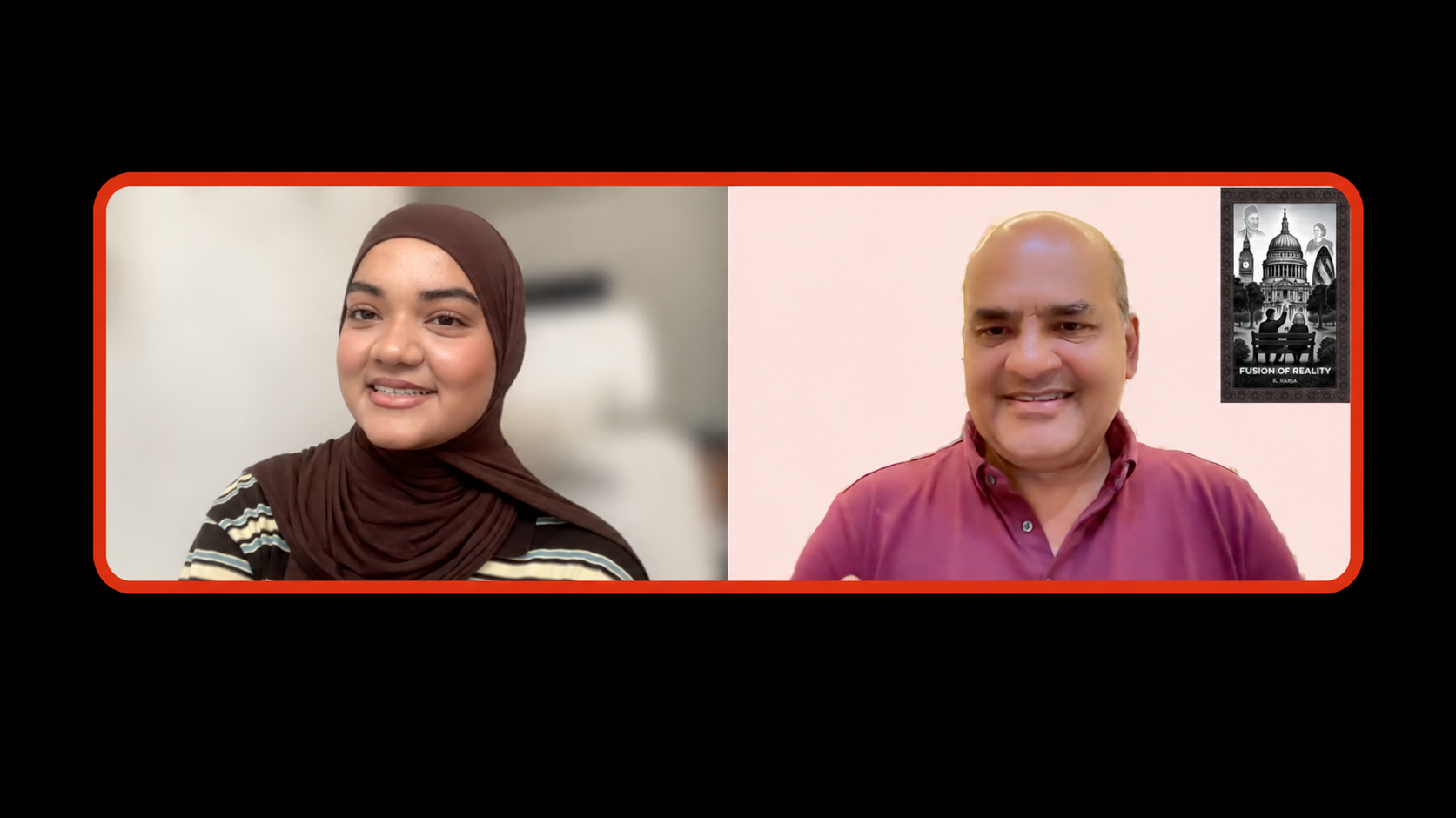
Welcome to this exclusive conversation with Ketan Varia, exploring the ideas, inspirations and questions at the heart of Fusion of Reality.
Every reader finishes Fusion of Reality with a set of different questions. In this conversation, Fatima sits down with Ketan Varia to go beyond the plot and explore the ideas behind the novel, from writing complex characters to identity, grief, family, creativity, and what success really means today.
Before turning to the novel itself, we begin by getting to know the author behind it. After more than 25 years helping organisations navigate change, K. Varia reflects on how becoming a novelist compares with a career in consulting.
Every novel begins with a decision. Rather than writing another business book, K. Varia discusses why storytelling was the right medium to examine ambition, identity and belonging.
At the centre of the novel is Aman, a protagonist who is often flawed, occasionally frustrating, yet deeply human. We explore the challenge of creating a character readers may not always agree with, but can still understand.
Whether speaking with strangers, colleagues or family members, Aman’s willingness to listen gradually reshapes how he sees the world. We discuss the moments throughout the novel that signal Aman’s shift away from defining success through achievement and towards asking deeper questions about meaning and fulfilment.
One of the novel’s strengths is its refusal to divide people into heroes and villains. Instead, readers are invited to understand every character’s motivations, even when they disagree with their choices. Here, K. Varia explains why simply being present for someone can matter more than trying to fix their pain.
Family relationships evolve alongside us. As Aman moves from being a son to becoming a parent himself, the novel offers a new perspective on responsibility, sacrifice and understanding previous generations.
Throughout the story, Aman balances his British and South Asian heritage alongside his professional ambitions, family life and personal passions. We explore how these overlapping identities shaped the noveland the conversations K. Varia hopes it will inspire.
Sometimes, the greatest influence on our lives comes from people we barely know. From Edith to chance encounters throughout the story, strangers repeatedly challenge Aman to see himself differently. We discuss why these brief relationships become some of the novel’s most significant.
Beneath the surface, Fusion of Reality is rich with symbolism. Small details, from recurring objects to everyday observations, gain new meaning as Aman changes, revealing how our values shift alongside our perspective.
Although burnout is an important part of Aman’s experience, the novel asks much larger questions about how we measure a meaningful life. K. Varia reflects on the central idea he hopes readers continue thinking about long after finishing the book.
Another lens through which Aman interprets his experiences is Buddhism. Rather than providing answers, it offers a quiet framework for reflection, encouraging readers to consider uncertainty, compassion and perspective in their own way.
Art also becomes a place of refuge throughout the story. As Aman reconnects with creativity, we explore what art allows him to express that his professional life never could, and why creativity remains essential, even in today’s career-focused world.
Without revealing the ending, we examine why Fusion of Reality resists offering easy resolutions. Instead of certainty, Aman discovers something profound: the ability to live with ambiguity, recognising that growth often comes from embracing life’s unanswered questions.
The themes of grief and loss became especially personal during the editing process. K. Varia reflects on how experiencing grief himself influenced the final version of the novel and deepened its emotional honesty.
Looking beyond the story, we consider how Fusion of Reality encourages readers to rethink one of society’s most familiar ideas: success.
Which leads to perhaps the novel’s biggest question: If success is no longer the destination, what does contentment actually look like? K. Varia shares how his own answer has evolved.
To conclude, we return to Aman himself. After everything he has experienced throughout the novel, what advice would he offer someone just beginning their own career?
By Fatima Faridul
PS – If you have 40 minutes watch the full interview.